
Jambon du Kintoa
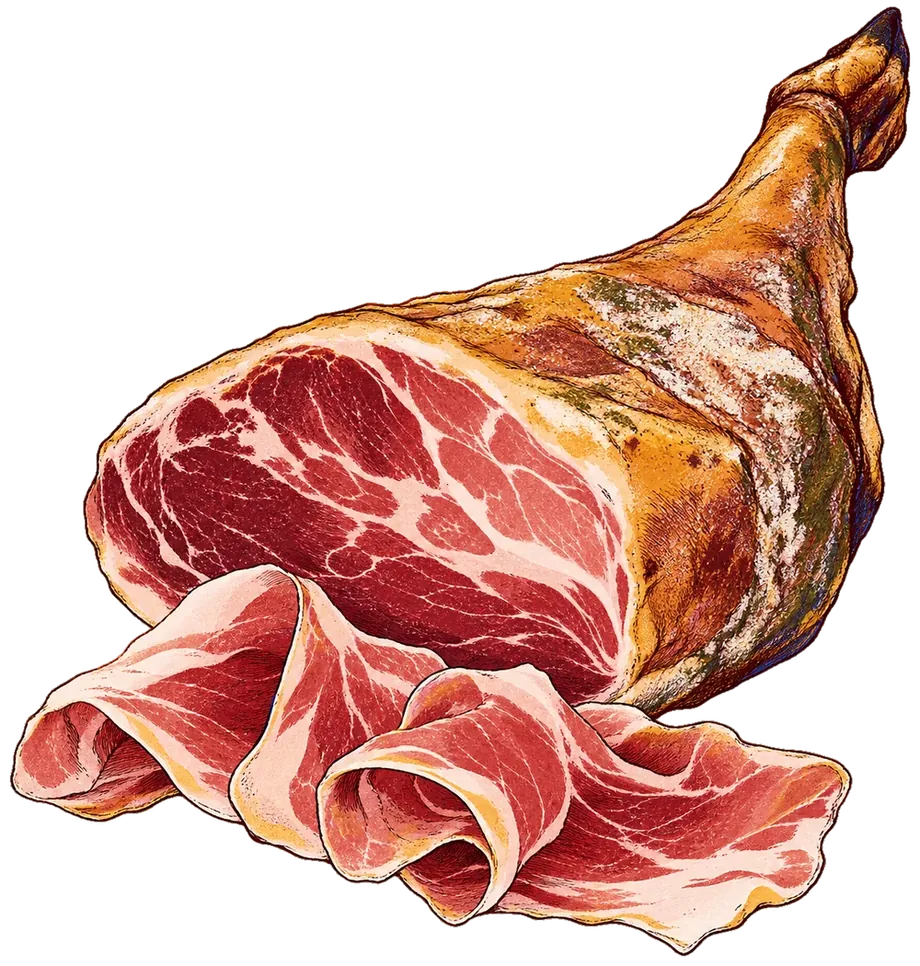
Kintoa is a dry-cured ham from the French Basque Country, made only from the Pie Noir du Pays Basque pig raised outdoors, and cured for at least 16 months under a Protected Designation of Origin.
- Region
- French Basque Country
- Sign
- PDO (AOP in French)
- Breed
- Pie Noir du Pays Basque
- Rearing
- Outdoors, pasture and woodland
- Ageing
- 16 months minimum, 18 to 24 in practice
- 2Saucisse sèchea Copain: a saucisson or salami
- 3Chorizo basquea Tête brûlée: spiced or smoked
- 4Boudin basquea Gourmand: cooked, to slice or spread
The short version
- What it is. A dry-cured ham, in the family of Parma and Serrano, made from one rare Basque pig.
- Why people seek it out. Its fat melts in the mouth and carries the flavour. Only a few thousand pigs are raised each year.
- How to eat it. Very thin, fat left on, at room temperature, on its own.
- What it costs. About €12 per 100 g, sliced, from the maker in France (Pierre Oteiza, November 2026).
- Can't find it? It is rare in British shops. The closest thing on a London counter is a good jamón ibérico, sliced to order. A Bayonne ham aged twelve months or more is the gentler, cheaper cousin.
What sets it apart
- Kintoa is defined by its pig. One breed, raised outdoors, in one small territory: that is what its PDO adds. A PDO (Protected Designation of Origin, AOP in French) is a legal label: every step must happen in one named place.
- The breed nearly disappeared in the early 1980s. Every Kintoa is also a conservation story.
- Its fat is the point. Do not trim it.
The storyThe pig that came back
The Pie Noir du Pays Basque is easy to recognise: black head, black rump, pink in the middle, ears falling over its eyes. It is a slow-growing, hardy pig that lays down fat between its muscles, the opposite of what modern farming wanted. By 1981 it was declared close to extinction, with only a few dozen breeding animals left. A handful of farmers in the Aldudes valley, led by Pierre Oteiza, rebuilt the herd. Today around eighty farmers raise a few thousand pigs a year. That is the scale of Kintoa: tiny next to Bayonne's million hams.
The signWhat the PDO guarantees
A PDO ties every step to one place and one way of doing things. For Kintoa, that means:
- One breed. Pie Noir du Pays Basque only.
- Outdoors. The pigs live on identified plots of pasture, heath and broadleaf woodland, which the INAO (the French body that runs these signs) approves one by one. They go out on these plots by five months old at the latest and stay there until the end. They are raised for twelve to twenty-four months, at least twice as long as a standard pig.
- A heavy, whole leg. At least 10 kg once trimmed, cut long, with the whole foot left on.
- Time, and fresh air. At least 16 months from salting to sale, with ten months or more in natural conditions: windows open to the mountain air rather than fully climate-controlled rooms.
- Local salt, local pepper. The ham is salted with salt from Salies-de-Béarn, a spring-salt town in the same corner of France, and its cut face is rubbed with Espelette pepper before it leaves.
The rule and the practice
The PDO sets a floor, not a target. Most of the Kintoa you will meet has been cured well beyond it.
| The rule (PDO) | In practice | |
|---|---|---|
| Total cure | 16 months minimum | 18 to 24 months is usual; the Basque farm producers’ charter recommends more than 24 |
| In natural air | 10 months minimum | Most of the cure, in drying rooms open to the mountain wind |
| Pierre Oteiza, Les Aldudes | Same rules | 18 to 24 months; 20 to 24 for a whole ham on the bone |
What it means for you: a 16-month Kintoa is legal, a 20 to 24-month one is what most people mean when they talk about it. Ask the age, and expect to pay a little more for the older ham.
At the counterHow to choose one
- Check the words « Jambon du Kintoa » and the red-and-yellow PDO logo. « Porc basque » alone is not the same thing.
- Look at the fat. White to pale pink, generous, soft to the touch. On Kintoa, a thick rim of fat is a sign of quality, not of waste.
- Ask the age. Sixteen months is the legal minimum; good makers usually go to 18 to 24. Ask for 20 months or more.
- Buy it sliced to order, ideally by hand.
Ask for it like this« Is this the PDO Kintoa? Could you slice it by hand, and leave the fat on? »
TastingWhat it tastes like
Three things work together. A slow-growing breed with fat inside the muscle; a long outdoor life spent moving, which darkens and firms the meat; and a long cure in natural air, which lets the fat develop. The result is a ham whose fat melts at body temperature and carries most of the flavour: nutty, slightly sweet, with a long savoury finish. The meat is a deep rose to red, finely marbled.
ServingHow to serve it
As thin as you dare, by hand, never trim the fat.
Out of the fridge 20 to 30 minutes before, longer in winter: the fat needs to soften. Slice as thin as you can, by hand if possible, and keep the fat on every slice. Eat it on its own first; bread comes second.
What not to do. Kintoa is not a cooking ham: heat wastes what you paid for.
In the glassWhat to pour
BearingsWhere it sits
| Kintoa | Bayonne | Jamón ibérico | |
|---|---|---|---|
| Sign | PDO | PGI | PDO or quality standard |
| Breed | Pie Noir du Pays Basque only | Any | Iberian pig, pure or crossed |
| Pigs outdoors | Required | Not required | Depends on the grade |
| Minimum cure | 16 months | 7 months | Varies by grade |
Houses to know. Pierre Oteiza, in Les Aldudes, which cures its Kintoa for 18 to 24 months.
VocabularyWords you will hear
- Pie Noir
- The breed.
- Parcours
- The outdoor plots where the pigs live, each one approved for the PDO.
- Pays Quint
- The mountain territory in Basque Country that gave Kintoa its name.
QuestionsQuestions people ask
What is the difference between Kintoa and Bayonne ham?
Kintoa is a PDO: one breed, raised outdoors, every step in a small Basque area, and at least 16 months of curing. Bayonne is a PGI: any breed from 21 départements of the South-West, at least seven months of curing in the Adour basin. Kintoa is a rarity; Bayonne is a family that runs from everyday to remarkable.
Why is it called Kintoa?
It is the Basque name of the Pays Quint, the mountain territory around the Aldudes valley. The name comes from the quinta, a right by which the kings of Navarre took one pig in five from the herds driven to graze in their forests.
Is Kintoa the French jamón ibérico?
It plays in the same league: an old breed, outdoor life, fat inside the muscle, a long cure. But it is a different pig, a different landscape and a far smaller production.
Why is Kintoa so expensive?
A pig raised twice as long, outdoors, on a small farm, then a ham cured for at least 16 months. Few are made, and none of it can be hurried. Expect about €12 per 100 g sliced, bought from the maker.
Where can I buy Kintoa ham in London?
It is rare in British shops, and we have not yet found a London counter that stocks it all year. The nearest experience is a good jamón ibérico sliced to order. If you spot Kintoa in London, tell us: we keep the list up to date.
For the recordThe rules in full
Pigs of the Pie Noir du Pays Basque breed, born and raised in the PDO area of the French Basque Country and neighbouring communes, raised for 12 to 24 months and kept on outdoor plots approved by the INAO from five months old at the latest. Salt from Salies-de-Béarn; cut face rubbed with Espelette pepper; at least 25 % of weight lost during the cure. Fresh ham at least 10 kg trimmed, long cut, whole foot. At least 16 months from salting, of which at least 10 months in natural conditions. In practice, 18 to 24 months is usual (Pierre Oteiza: 18 to 24; farm producers’ charter: more than 24 recommended).
Source: specifications of the PDOs « Kintoa » and « Jambon du Kintoa » (INAO), version approved on 5 May 2026.
105 cards to go. One every Thursday.
One email a week. The first 5,000 members get a numbered founding card.